

(7 minute read)
The Green Bean Collective was just acknowledged as a Good Food Organization for 2026. Since getting the news, I’ve been reflecting on how we got here.
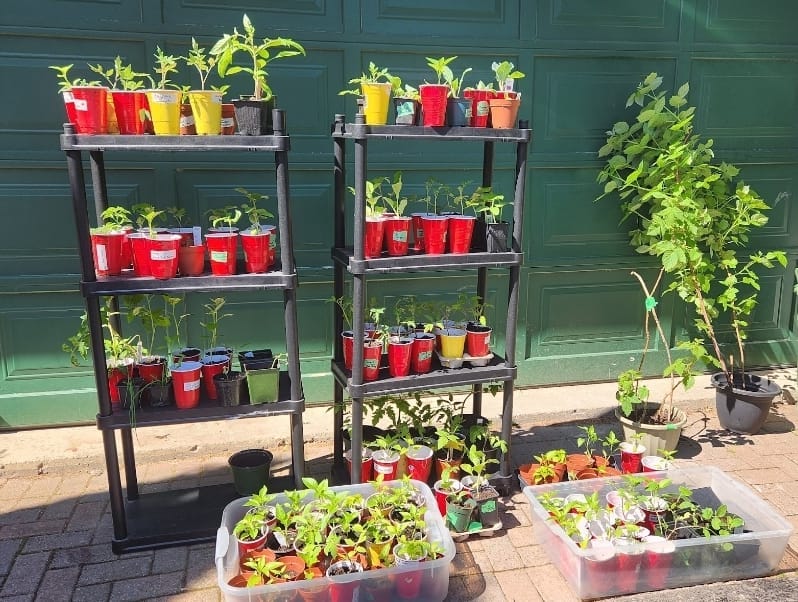
The pandemic locked us down and pushed my kids and I toward the garden. We grew seedlings, and as it is with seeds, we grew more than we could use. The kids hosted a plant sale, delivered extras to neighbors, and, in the end, we gave them away to people who could use them.
See here, a picture of us sunbathing the baby plants, as they await their new homes:
That’s when I realized: we don’t just have a food problem. We have a village problem.
Planting seeds
What struck me wasn’t the plants themselves - although the sheer abundance of seeds inside a tomato that could grow exponential tomatoes into the future is awe inspiring. It was how hungry people were for connection. For someone to say: “here, I grew this for you” or the look on their face when we said, “if you plant this, you can grow it.”
Even as we eased out of the pandemic, and people’s victory gardens and sourdough hobbies waned, I realized how isolated I was. Sure, I had a community. By this time, I also had a community garden plot and folks around me to grow things with. But, I was far from my family, navigating a challenging marriage, raising kids in a time of uncertainty. Sure, I had a network: my church, my work colleagues, my friends back home or online. But I didn’t have a village. There was the odd moment of seeing myself in content, like, in this short from Jennifer Fulwiler, who often talks about how the suburban, nuclear family created a lot of isolation since 1950s America:
But, I didn’t have the village my brain was designed and had evolved to thrive in. Western modernity’s village doesn’t come with people built-in that can help you plant tulip bulbs, grab a quick shower after the kids were up all night, bring you a cup of sugar when you run out. Yes, I could call my mom several provinces away. Yes, I could and did hire a Mother’s Helper (hi, Michele!). But, I kept imagining what community building, food sharing and rescue… a village, could look like if we got more intentional.
Asking (more) questions
Harvest season 2024. I saw a video from Gagan Singh where he was planning to give away the berries on his family’s farm.
See his video here, but he shares a lot of content about reimagining farmer’s markets and farming in general:
It got me thinking more and more critically about our food system and seeing if there were ways to get involved in similar projects. So, in September 2024, I tentatively posed the question in my local gardening exchanges (a place where we traded plants and seeds) : Are there any gleaning groups in the area?
The responses were telling.
Some people were confused:
“Just wondering why there would be crops the farms would leave behind. Is this a normal occurrence? I’ve not heard of this in Ontario.”
Others worried about boundaries:
“Why would any farmer or homeowner want someone on their property?”
and:
“People used to just hop the fence and help themselves when I was growing up. Always felt it was super rude because no one ever asked.”
None of these responses were unkind - ok, maybe one or two. But together, they revealed something: my community didn’t yet understand organized, consent-based food sharing. It didn’t have the kind of village-building it requires.
The real question underneath was: How do I build a village in this season of my life?
Winter came and I planted trays of coleus seeds. They take a long time to get started, sometimes you think they don’t germinate. I knew from prior years, that once they do, they’re well worth it.
Reaching out
In February, I started some hot peppers.
In March, I planted few extra bell peppers for the food bank garden hoping they would make it this time. I never do well with peppers.
With a fresh new year and planting season ahead of me, I set out to find my people.
I was encouraged to get intentional about building this, by taking small risks and offering and asking for help. One creator who really got me thinking about this was Rachel Lovely in her video about how her mom shapes a “bustling metropolis” of villages wherever she goes. It reminded me of the community my own family has “back home,” even if we never had a word for it.
What struck me about Rachel’s video wasn’t just about offering help and being there, but having the courage to ask for help, too. So, in the spring of 2025, when I saw Heather was looking for volunteers and homeowners interested in fruit tree harvesting I told myself to channel Brene Brown: “connection is why we’re here.”
We met for coffee (Heather and I, not Brene and I) and what has grown is more than just collaboration. It was a fast, grounded friendship. The kind that forms when values align and timing matters.
Creating structure
Spring 2025, we had a seed exchange. Through the growing season of 2025, we worked on projects together. I helped her get a plot at my community garden. We got people together for fruit tree harvesting, donated hundreds of pounds of fruit to food banks, hosted a garlic planting workshop this fall.
Most recently, Heather and I happened upon this post by Ebby Moyer about how to back away from “Big Consumerist Christmas.” Within a couple of weeks, The Green Bean Collective + lots of volunteers organized our first annual Christmas Décor and Gift Exchange along side Hebron Christian Reformed Church and the Hebron Community Gardeners, with all proceeds going to Gate 3:16, a local charity in Oshawa that supports the homeless.
Maybe the icing on the cake for me: not only did we raise money for an important cause, reduce waste and share beautiful things with our community, we were able to share apple cider made from local apples from the fruit harvesting project.
And, this month, we were recognized as a Good Food Organization for 2026.
The Green Bean Collective redistributes surplus food, yes, but also redistributes effort, tools, knowledge, and care.
We are proud to align with the Good Food Principles:
Take action from the individual to the systemic level.
Invest in the power of good food.
Create an environment of respect and community leadership.
Meet people where they’re at.
Aim high for our organization and for our community.
This recognition from Right to Food is about something bigger than food redistribution. Yes, hunger is on the rise but so is loneliness and isolation. We also hope to counter some of the issues that surround asking for help and receiving it in a dignified manner. There is dignity that comes from being invited to a meal and into community. Getting recognition as a Good Food Organization is validation that village-building works. That when you create structure where there was uncertainty, language where there was confusion, an invitation where there was hesitation, people respond.
In addition to food rescue and distribution, we have a lot of other project ideas we’re working on bringing to life such as:
A tool and resource library (for gardening, preserving, and DIY projects)
Workshops and skill shares - from seed saving to mending to fermentation
A community café or co-op space, we hope to build a “third place” to gather, create, and collaborate (that’s the dream!)
Expanding our fruit harvesting and redistribution network so surplus food nourishes more people
Creating think-outside-the-box ways to help people with no garden start growing their own food
Building a mutual aid network that thrives on reciprocity, not charity
Join us
We’re building this together. One conversation, one harvest, one act of generosity at a time. Please join us or at least follow along the journey. Everyone is welcome.
Follow us on Facebook: The Green Bean Collective